The propAMM platform for tokenized stocks on Base.
Better prices for traders. Lower costs for market makers.
WHY propAMMs
Active pricing beats a fixed curve.
An AMM prices every trade from the same stale bonding curve. A proprietary AMM puts a professional MM behind pricing instead, updating prices in response to CEX prices. Most of Solana's onchain volume is now pAMMsbecause they have better prices & lower slippage.
But today, each propAMM still operates as a separate venue. HyFi fixes that.
The problem
PropAMMs work. Fragmented liquidity doesn't.
Running propAMMs independently duplicates the infrastructure that keeps them fresh onchain, and scatters their liquidity across unrelated pricing sources. HyFi collapses both into one platform.
Independent propAMMs
Duplicated updates
Every propAMM separately pays to keep its own prices fresh onchain.
Higher costs for market makers
Fragmented liquidity
Aggregators can’t split trades across pAMMs optimally because they’re black boxes, and the route calculated offchain becomes stale by tx execution time.
Worse prices for traders
One shared platform
Shared updates
One aggregated (compressed) onchain update represents quotes from all MMs.
Vastly lower costs for MMs, passed on as better prices
Unified liquidity
All MMs quote into one shared book; trades consume the mathematically optimal prices at execution by simply walking the book.
Better prices for traders
Case study on Base
Professional pricing beats passive AMMs.
HyFi returned the best price on 37–61% of samples, depending on order size and direction, while deploying roughly 50–500× less capital than the pools it was measured against.
Read the case studyof quotes where HyFi had the better effective price than every comparable Uniswap pool.
Win rate by order size
- $10,000
- 51–61%
- $1,000
- 39–49%
- $100
- 37–47%
Not a guarantee of future performance.
The market
Built for tokenized stocks.
HyFi performs best on assets that have far higher liquidity offchain than onchain, so tokenized stocks are the natural fit.
Deep reference markets
Equities have some of the deepest markets in the world, which is exactly what a professional market maker needs to quote tightly and hedge effectively.
Young onchain liquidity
Their onchain counterparts are new and spread across venues. That gap between reference pricing and onchain depth is where active market making has the most room to improve execution.
Live on Base
Base is where that liquidity is forming, and where cheap blockspace makes a frequently refreshed shared orderbook practical. HyFi is running there today.
How it works
Quote offchain. Execute onchain.
HyFi is a hybrid of a DEX and a CEX to get the best of both. AMMs' dominance over RFQ shows that traders want immediate execution onchain. MMs want to be able to update their orders constantly for free, like a CEX.
 Built as a Uniswap v4 hook. HyFi went through the Uniswap Hook Incubator.
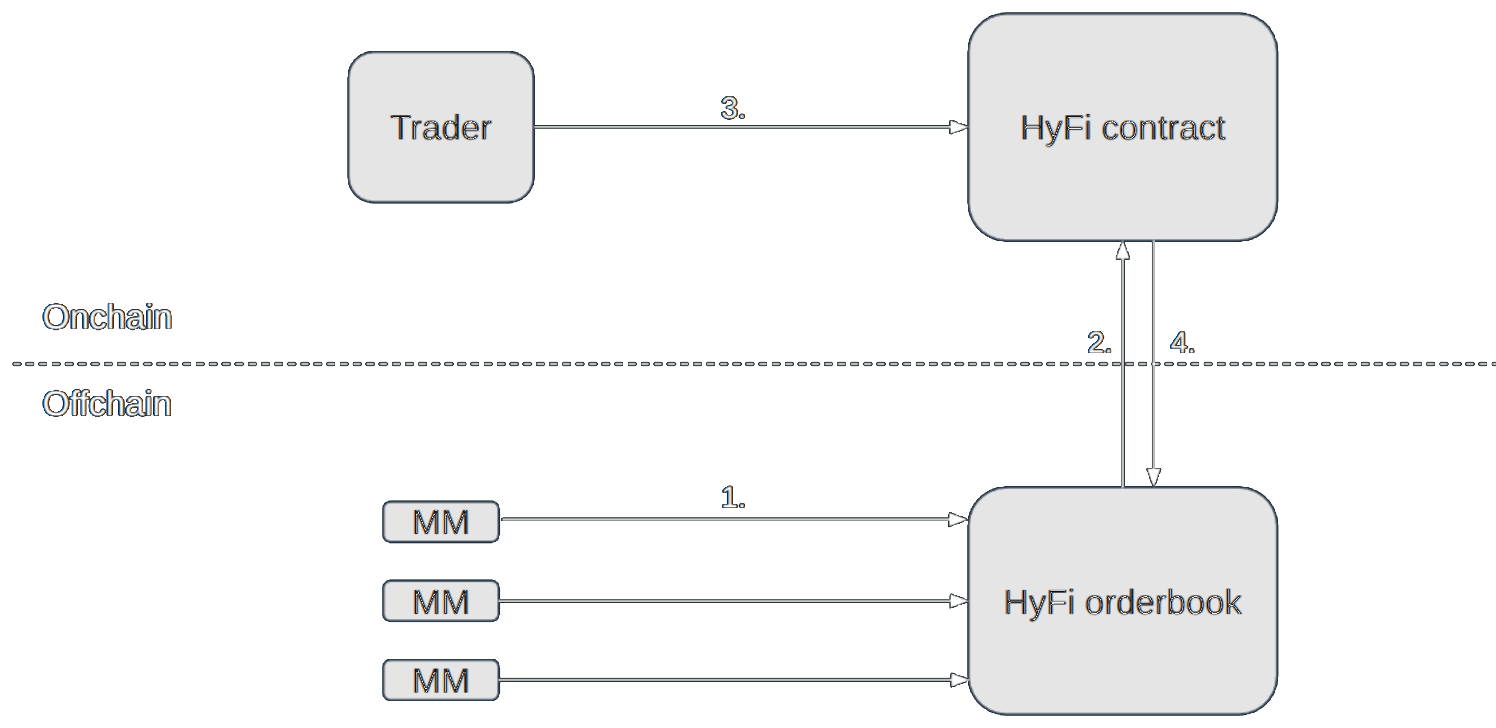
Market makers quote offchain
MMs place/update orders in HyFi’s offchain compressed orderbook for free via API like a CEX.
HyFi snapshots
HyFi takes a snapshot and puts the book onchain cheaply via compression.
Trades
Traders trade against the orderbook as if it were a regular AMM, walking the book for the best price at execution time.
HyFi updates MMs
HyFi updates the offchain orderbook and balances of MMs to reflect trades.
Offchain only
- MM quoting
- Who owns which liquidity
- Balance adjustments after trades
Onchain only
- MM’s tokens
- Trade execution & token settlement
- Price and total liquidity of each nearby tick
Compression
Only the executable state goes onchain.
An orderbook is only economical onchain if the update data is small. HyFi strips away everything not needed by 99% of traders 99% of the time before the next orderbook update.
Learn how compression worksOne platform. Both sides gain.
HyFi hosts market makers and routes to them; it is not itself a market maker.
For market makers
Lower the cost of making markets onchain.
Shared update infrastructure
One aggregated onchain update carries all the book’s relevant liquidity, so you aren’t funding an update stream of your own.
A CEX-like offchain workflow
Quote and requote through an API, the way you already do. Your interaction with HyFi happens offchain.
Shared distribution
As HyFi gets integrated into more flow sources, you get more volume without having to do anything.
Active pricing, not passive exposure
Price and manage inventory against external markets instead of sitting on a fixed curve waiting to be traded against.
Arbitrage protection
HyFi prevents arbitrageurs from taking orders if they become stale.
For traders & aggregators
One venue, many market makers.
Combined liquidity
Reach the pooled liquidity of every participating market maker through a single book, instead of several independent propAMM pricing sources.
Priced at execution
A swap consumes the best available liquidity in the book when it lands, rather than following a split path across independent pAMMs that’s stale by tx execution time.
Onchain execution
Swaps settle through Uniswap v4 with your minimum-output check, straight from your wallet. If the price isn’t there, the transaction reverts.
One integration to maintain
Integrate the book once. Every market maker that joins improves the same venue you’re already routing to.
Two places to start.
Read how the shared book is aggregated, compressed and executed, or open the app and see what's live on Base right now.